Introduction to the Use of Right-Angle Prism
I. Product Overview
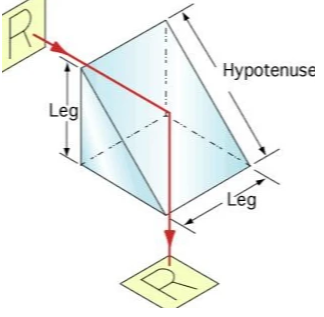
The right-angle prism is one of the most fundamental and widely used optical components in optical systems, typically made from optical glass, quartz, or other transparent materials. Its core structure is a triangular prism with a 90° right angle, with the two right-angle sides serving as the incident and emergent surfaces, and the hypotenuse as the reflective surface. Through total internal reflection or coated reflection, the right-angle prism can achieve 90° deflection of light, image inversion, or optical path folding, and is widely used in imaging, laser, spectral analysis, and precision optical instruments
II. Usage Introduction
1. Core Functions and Application Scenarios
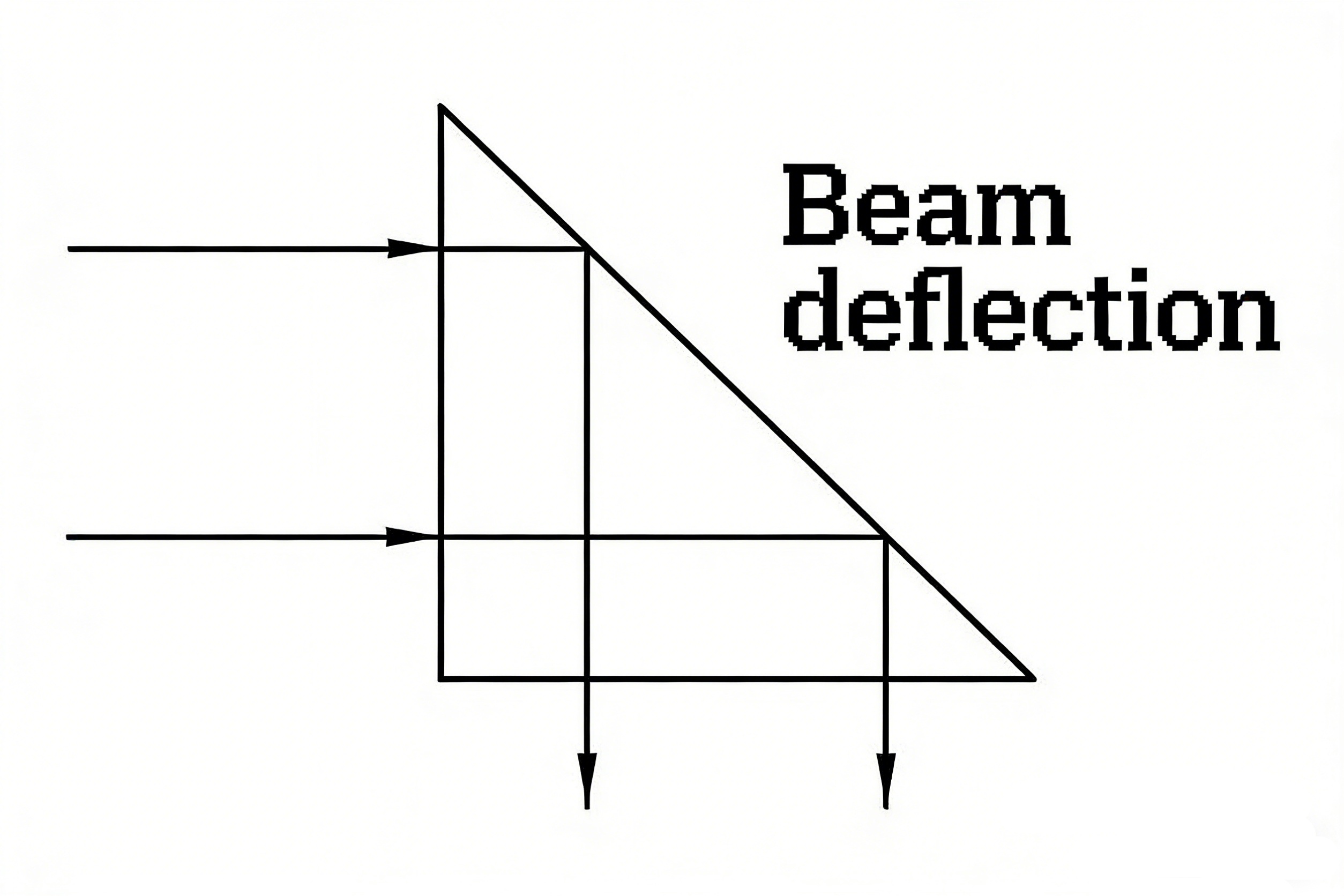
90° Light Path Deflection: Deflects the incident light by 90°, used for compact optical system layout and space reduction.
Image Inversion and Direction Change: Can achieve vertical/horizontal image inversion or change the propagation direction, commonly used in telescopes, microscopes and other imaging systems.
Light Path Folding: Folds the light path through multiple reflections to achieve a long optical path in a limited space, enhancing system integration.
Laser Systems: Serves as a reflective element in laser resonators or for beam steering and shaping.
2. Usage Precautions
Incident Surface Selection: Light usually enters from the right-angled side, reflects off the hypotenuse and exits from the other right-angled side; if the hypotenuse is coated with a reflective film, a higher reflectivity can be achieved.
Total Internal Reflection Conditions: When light enters the hypotenuse from a denser medium (such as glass), if the incident angle is greater than the critical angle, total internal reflection without loss can be achieved without the need for coating.
Environmental Requirements: Avoid use in high-temperature, high-humidity or strongly corrosive environments to prevent damage to the optical surface or film layer peeling.
Installation and Alignment: During installation, ensure that the optical surfaces of the prism are strictly perpendicular/parallel to the light path to avoid introducing additional aberrations or light axis shifts.
III. Manufacturing Instructions
1. Material Selection
Optical glass: such as BK7, K9, with good optical uniformity and transmittance, suitable for visible light and near-infrared bands.
Fused silica: with high ultraviolet transmittance and good thermal stability, suitable for ultraviolet lasers and high-precision applications.
Infrared materials: such as silicon, germanium, used in infrared optical systems.
2. Processing Techniques
1. Rough cutting: According to the design dimensions, the raw materials are cut into prism blanks close to the finished product.
2. Coarse grinding and fine grinding: Through grinding processes, right-angle edges and beveled edges are gradually processed to ensure angle accuracy and surface flatness.
3. Polishing: Using chemical mechanical polishing (CMP) and other processes, the optical surfaces are processed to a super-smooth surface to reduce scattering losses.
4. Coating (optional): According to application requirements, high-reflective coatings (such as aluminum, silver, dielectric coatings) are applied to the beveled edges, or anti-reflection coatings are applied to the incident and exit surfaces.
5. Inspection and calibration: Using interferometers, angle gauges, and other equipment, the surface shape accuracy, angle error, and optical performance are inspected to ensure compliance with technical specifications.
3. Quality Control
Angle accuracy: The right-angle error is usually controlled within a few seconds to a few minutes to ensure the accuracy of light path deflection.
Surface quality: In accordance with ISO 10110 standards, surface defects such as scratches and pits are controlled to avoid affecting optical performance.
Coating reliability: The adhesion and durability of the coating are verified through environmental tests (temperature cycling, humidity tests).
Recent Articles