A Comprehensive Analysis of the Production Process of 8mm Focal Length M12 Autofocus Liquid Lens
Precision Manufacturing | A Comprehensive Analysis of the Production Process of 8mm Focal Length M12 Autofocus Liquid Lens
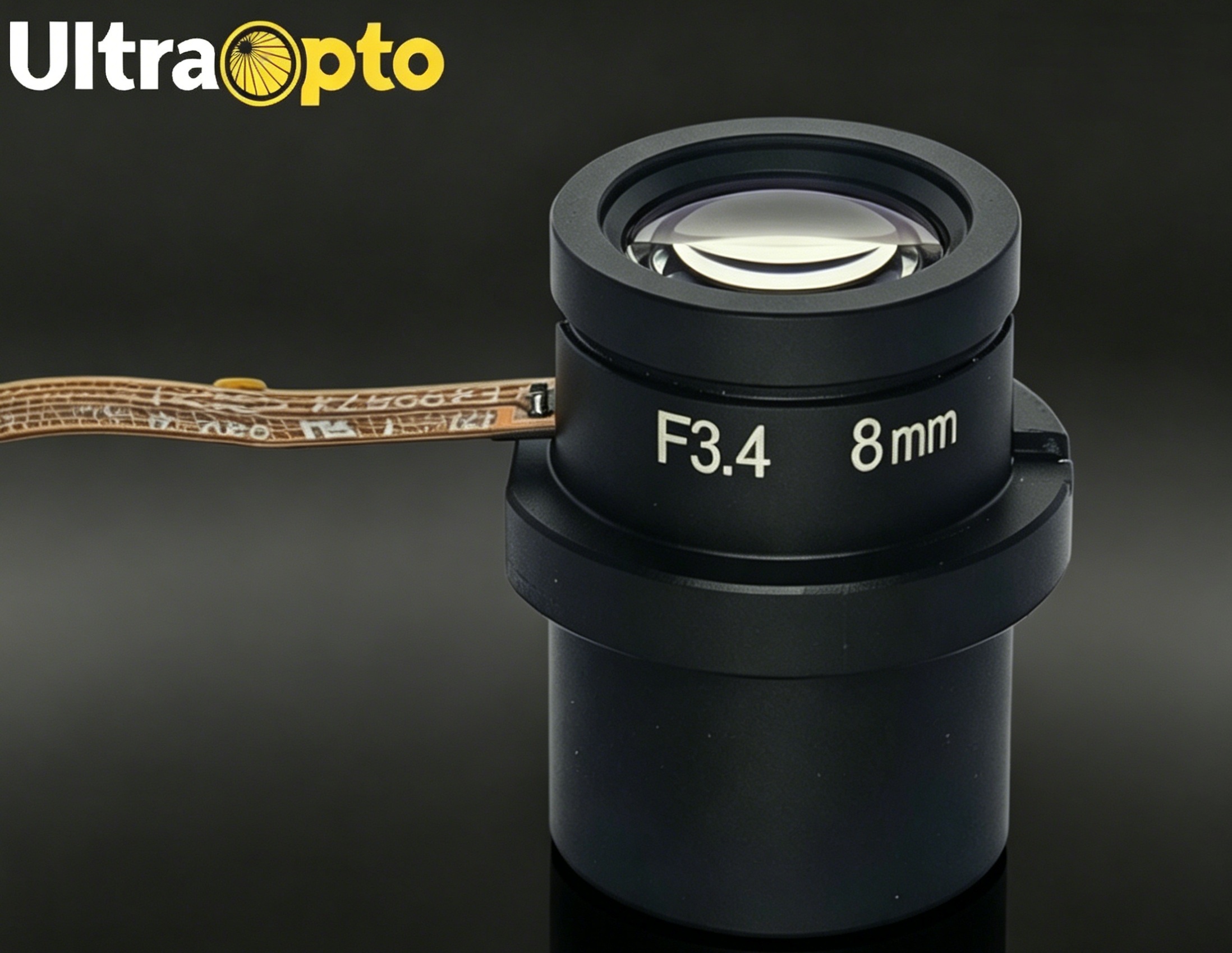
The UltraOpto 8mm M12 autofocus liquid lens, with electrowetting effect as its core, undergoes the full-process precision manufacturing in a Class 1000 cleanroom. It achieves zero mechanical wear and millisecond-level focusing, and is specially designed for high-precision scenarios such as industrial vision, security monitoring and smart devices. The complete precision production process is as follows:
1. Raw Material Selection and Pretreatment
Select high-purity optical glass, low-refractive-index silicone oil and high-stability conductive liquid to ensure light transmittance and interface uniformity.
Aerospace-grade aluminum alloy is adopted for metal structural components, which are precision-machined by CNC to guarantee M12 thread accuracy and structural strength.
All incoming materials must pass strict tests on refractive index, transmittance, density and insulation to eliminate impurities and defects.
2. Precision Grinding and Polishing of Optical Lenses
Glass lenses go through four processes: precision cutting, rough grinding, fine grinding and polishing, achieving submicron-level surface accuracy with surface roughness < 0.01μm.
Vacuum coating is used to deposit broadband anti-reflection coating, reducing reflection loss and improving the light transmission consistency across the entire waveband.
3. Preparation of Core Unit of Liquid Lens
Cavity Microfabrication:
Microfluidic cavities are etched on ceramic/glass substrates, and hydrophobic insulating coatings are applied to ensure stable liquid without leakage.
Electrode Deposition:
PVD process is used to deposit annular control electrodes with micron-level patterning accuracy, ensuring uniform electric field distribution.
Precision Liquid Injection:
Equal amounts of insulating oil and conductive liquid are injected in a negative pressure environment. The two liquids have matched density and are immiscible with each other, forming a stable optical interface.
Vacuum Encapsulation:
The cavity is sealed by laser to prevent bubbles, dust and water vapor, ensuring no performance degradation during long-term use.
4. Precision Assembly of M12 Interface and Structure
The liquid lens unit, lens holder, spacer ring and base are coaxially assembled on an optical alignment platform with concentricity error < 0.001mm.
The standard M12×0.5 threaded interface is adopted to ensure perfect compatibility with mainstream camera modules, featuring stable installation without loosening.
Flexible Printed Circuit (FPC) is precisely soldered to realize stable transmission of electronic control focusing signals.
5. Focus Performance Calibration and Debugging
Different voltages are applied through a programmable power supply to calibrate the focal length-voltage curve, ensuring accurate and stable 8mm focal length.
Focus response speed, linearity and repeatability are calibrated for each unit, achieving millisecond-level ultra-fast focusing without delay or drift.
6. Full Performance Testing and Factory Verification
Optical Index Testing:
Detection of resolution, distortion, light transmittance, MTF and center/edge consistency.
Focus Function Verification:
Testing of focusing speed, accuracy, cycle life and high-low temperature stability.
Environmental Reliability Testing:
Simulation of high-low temperature cycling, damp heat, vibration and drop to ensure industrial-grade durability.
Final Appearance and Dimension Inspection:
Products can only leave the factory if they have no scratches or oil stains on the appearance, and 100% qualification of threads, dimensions and coaxiality.
With micron-level manufacturing process, closed-loop quality control and standardized technology, UltraOpto creates 8mm M12 autofocus liquid lenses with high stability, long service life and fast response, providing a reliable optical core for high-end imaging systems.
Recent Articles