New Product Launch | High-Performance Ultra-Narrow Bandpass Filter
UltraOpto New Product Launch | High-Performance Ultra-Narrow Bandpass Filter, Core of Nanoscale Precision Spectral Filtering
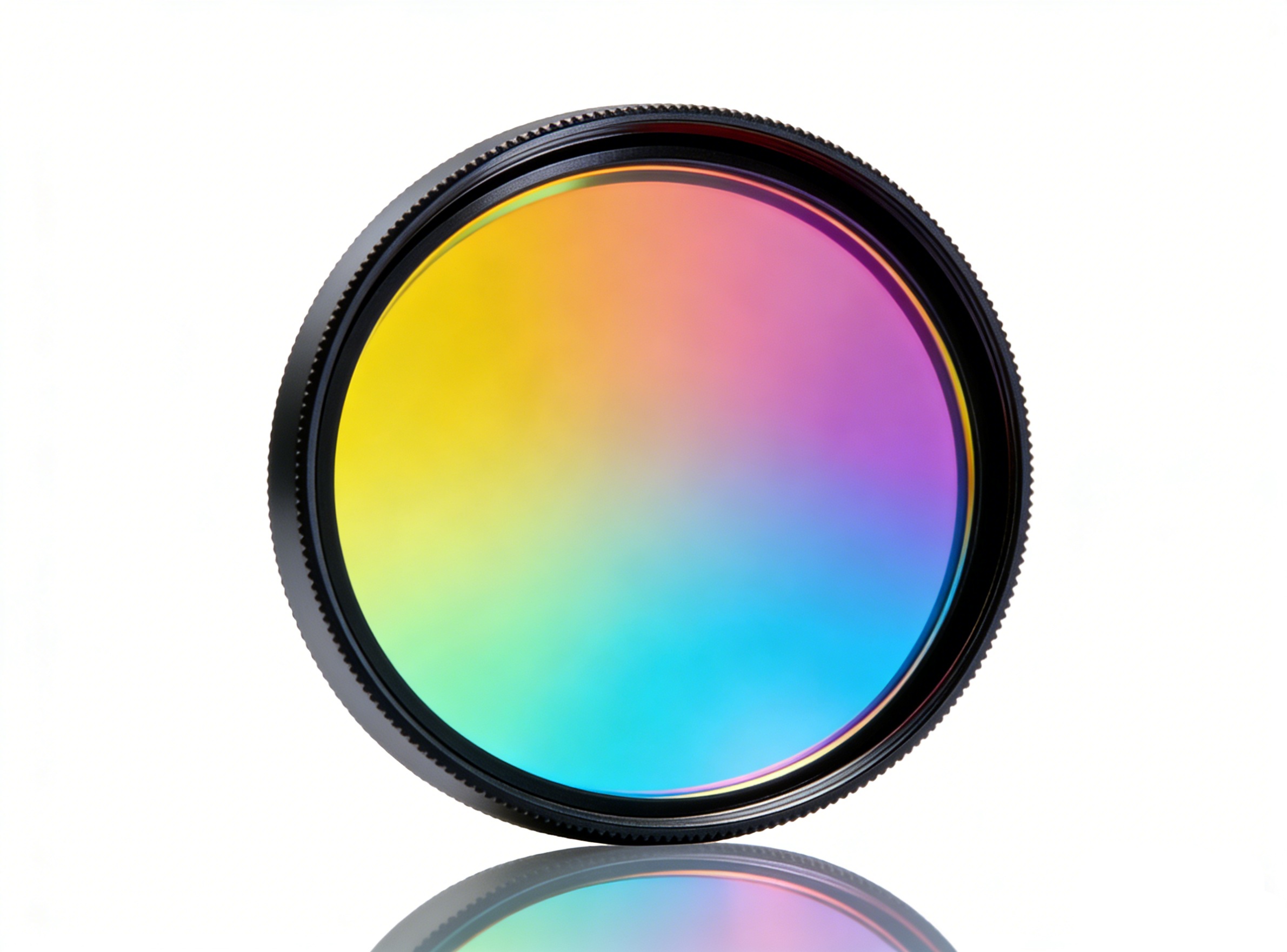
UltraOpto newly launches high-performance ultra-narrow bandpass filters (UNBPF). As high-end spectral filtering core components in the field of precision optics, relying on multi-cavity and multi-layer dielectric film interference and ultra-precision coating thickness control technology, they achieve precise spectral filtering with sub-nanoscale ultra-narrow bandwidth of 0.1nm~5nm. They also feature ultra-precise central wavelength, high transmittance in the passband, deep cut-off outside the band, and excellent environmental stability. They are key optical components in fields with extreme requirements for spectral accuracy such as lidar, quantum communication, astronomical observation, and high-resolution spectral analysis.
The product supports customization of central wavelengths in the full range of 250nm~1800nm for ultraviolet, visible, and near-infrared bands, covering mainstream laser/detection wavelengths such as 405nm, 532nm, 632.8nm, and 1064nm; the full width at half maximum is precisely controlled within 0.1nm~5nm, the central wavelength tolerance is as low as ±0.05nm~±0.2nm, and the wavelength uniformity deviation within the filter is less than 0.06%, realizing precise filtering of nanoscale optical signals; the passband has a flat-top characteristic, with a peak transmittance of ≥85% and up to 98% for high-end models, the out-of-band cut-off depth is generally ≥OD4 and can reach OD6~OD12 for customized models, and the band edge transition is extremely steep, which completely suppresses stray light interference and greatly improves the signal-to-noise ratio of optical systems.
The core substrate is preferably fused silica (UVFS/JGS1), which has good optical uniformity, weak autofluorescence, and high laser damage threshold; for ultra-precision working conditions, zero-expansion ULE glass can be customized, with a temperature coefficient as low as within 0.02nm/℃, effectively suppressing wavelength drift caused by temperature changes; for the infrared band, special substrates such as silicon and zinc selenide can be customized. Ion beam sputtering/plasma-enhanced deposition ultra-precision hard coating technology is adopted to deposit more than 100 layers of high and low refractive index dielectric film systems, with film thickness control accuracy reaching the atomic level (error ≤±0.1%). Combined with real-time wavelength monitoring and error dynamic compensation technology, it ensures a flat-top passband and ultra-steep band edges; the film layer is dense, scratch-resistant, corrosion-resistant, and can be cleaned repeatedly. The light-transmitting surface is coated with a special anti-reflection film to improve transmittance, and the edge is coated with a blackening film to suppress scattered stray light.
The conventional shape is circular, with mainstream sizes of Φ12.5mm, Φ25.0mm, and Φ25.4mm, and large-size specifications of Φ50mm~Φ100mm can be customized. The substrate thickness is 2.0mm~3.0mm, and the model with anodized aluminum frame is suitable for integrated installation; the dimensional tolerance is 0/-0.05mm, the effective light-transmitting aperture is >90%, the surface quality meets the ultra-high standard of 20/10 MIL, the wavefront distortion RMS value is as low as 0.01 wave @632.8nm, and the optical performance has no obvious drift within the incident angle of 0±3°, which is suitable for various precision optical path layouts. The finished aluminum frame is marked with core parameters and light propagation direction to improve usability. The central wavelength deviation between batches in mass production is ≤±0.3nm, with excellent consistency.
Before leaving the factory, they are fully tested by high-precision equipment such as high-resolution spectrophotometers and laser wavelength calibration platforms, covering all core indicators such as central wavelength, bandwidth, transmittance, and wavefront distortion; they have passed rigorous tests such as high and low temperature cycles (-50℃~+85℃), thermal shock, damp heat aging, and film adhesion/abrasion resistance. Under complex working conditions such as temperature fluctuations, humidity, and slight vibration, the optical performance does not drift and the film layer does not fall off, which is suitable for long-term continuous work in industrial, scientific research, and aerospace grades. They are widely used in lidar ranging, quantum communication/sensing, astronomical observation, Raman/atomic absorption high-resolution spectral analysis, and can also be adapted to high-end scenarios such as biomedical precision detection, atmospheric/gas sensing, and high-end laser system purification. Mainstream wavelength specifications are available in stock, and extreme parameters such as ultra-narrow bandwidth, ultra-high cut-off depth, and large size can be customized non-standard. Small-batch sampling is supported, and the delivery time is stable, providing nanoscale precise spectral filtering solutions for high-end precision optical systems.
Recent Articles