LVBF filters are newly launched
UltraOpto New Product Launch | Linear Variable Bandpass Filter, the Core of Wide-Range Dynamically Tunable Spectral Filtering
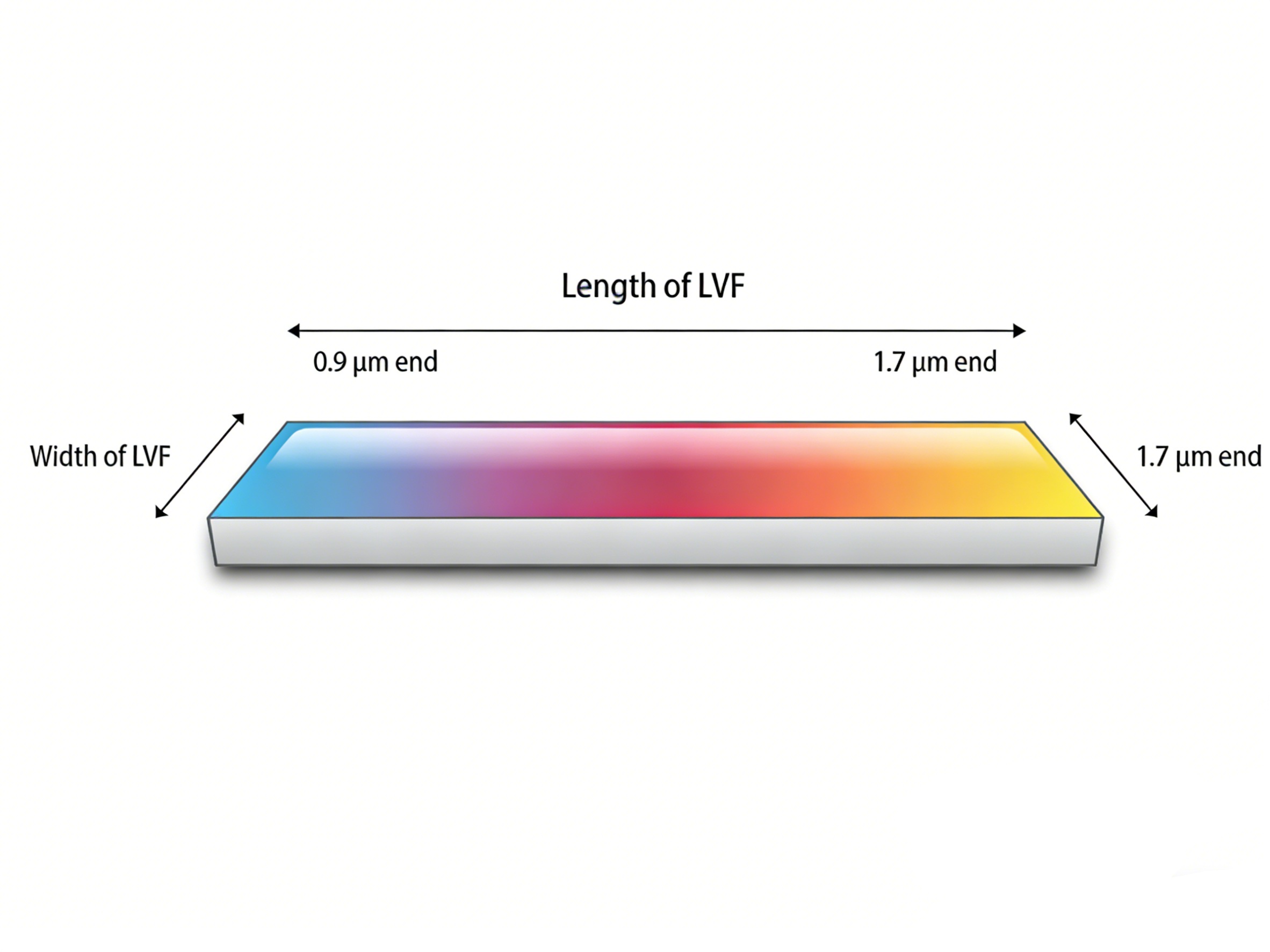
UltraOpto has newly launched the Linear Variable Bandpass Filter (LVBF). As a high-end core component for dynamic spectral filtering, it relies on wedge substrate gradient coating technology to achieve a linear and continuous change of the central wavelength along one dimension. A single piece can replace multiple fixed-wavelength bandpass filters, featuring a wide tuning range, high spectral resolution, narrow bandwidth, and high transmittance. It significantly simplifies the structure of optical systems and is a key component for realizing dynamic wavelength filtering in fields such as spectral analysis, hyperspectral imaging, and portable optical instruments.
The product's conventional tuning wavelength covers 400nm~1000nm, and it supports customization for an ultra-wide range of 200nm~1650nm. The linear gradient rate can reach 60nm/mm, and precise dynamic tuning of the central wavelength can be achieved by sliding/rotating without档位 switching gaps. The peak transmittance is generally ≥60%, and the high-end model reaches over 95%. The full width at half maximum can be precisely controlled within 7nm~400nm. The out-of-band cutoff depth is generally ≥OD3, and the customized model can reach OD4+. The performance is stable within an incident angle of 0±3°, ensuring accurate and efficient spectral filtering.
The core substrate is preferably fused silica (UVFS/JGS1), which has excellent optical uniformity, weak autofluorescence, and a high laser damage threshold, suitable for visible to near-infrared bands. For conventional scenarios, N-BK7/H-K9L optical borosilicate glass can be selected. For infrared bands, special substrates such as silicon and zinc selenide can be customized. The conventional shape is rectangular, with mainstream sizes ranging from 12mm×60mm to 40mm×40mm. The effective gradient light-transmitting area can be customized, and the substrate thickness is 2.5mm±0.1mm. It also supports personalized processes such as punching and plating positioning marks, adapting to compact optical path layouts.
It adopts ion beam sputtering/electron beam evaporation + ion-assisted deposition ultra-precision gradient coating technology, depositing alternating dielectric film systems with linearly varying thicknesses of high and low refractive indices on the wedge substrate, precisely controlling the film gradient rate to ensure the consistency of linear wavelength changes. The light-transmitting surface is coated with an anti-reflection film to improve transmittance, and the edges are coated with a blackened film to suppress stray light. The film layer has high compactness and strong adhesion, without falling off or deformation during long-term use. Strict control of processing accuracy: dimensional tolerance is ±0.05mm, central wavelength tolerance is ±2nm, linear gradient rate deviation is ≤±5%, wavefront distortion is ≤λ/[email protected], and the consistency of mass production is excellent.
Before leaving the factory, it undergoes full-dimensional testing with high-precision equipment such as high-resolution spectrophotometers and wavelength tuning test benches, covering core indicators such as tuning range, peak transmittance, and bandwidth. It has passed rigorous tests of high and low temperature cycles (-40℃~+85℃), damp heat aging, and film adhesion. The optical performance does not drift and the substrate does not deform under temperature changes and humid environments, adapting to long-term continuous work of industrial-grade and portable instruments. It is widely used in scenarios such as portable spectrometers, hyperspectral imaging (industrial inspection/agricultural remote sensing), biomedical fluorescence detection, laser system wavelength tuning, and infrared gas sensing. Mainstream specifications are available in stock. The tuning range, gradient rate, bandwidth, and substrate can be customized non-standard. Small-batch sampling is supported, and the delivery time is stable, providing miniaturized and highly reliable solutions for various dynamic spectral filtering optical systems.
Recent Articles